About · Cornerstone Genomics

Biodiversity as biomedical infrastructure.

80 million years of primate evolution contains a record of which genetic changes nature has tolerated — and which it has not.

Building a platform to make that record useful for human medicine required two decades of comparative genomics, an irreplaceable collection of biological samples, and an independent company to carry the work forward.

Founded 2017 · Delaware C-corpNSF SBIR I + II · $1.225MResearch use only
The Origin

From a question in evolutionary biology to a platform for human genomics.

Chapter 01 · NCI Laboratory of Genomic Diversity
22
Years as Staff Scientist studying how DNA changes across species and across millions of years of evolution.
Chapter 01

The science predates the company.

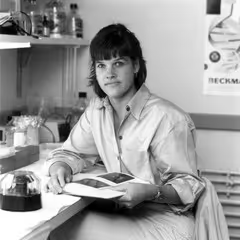
The scientific foundation traces back more than two decades, to Dr. Jill Pecon-Slattery's research at the National Cancer Institute. During 22 years at NCI's Laboratory of Genomic Diversity, her team studied how DNA changes across species and across millions of years of evolution. The lab's guiding mission was to look beyond humans to understand how genetics operates across life.

Her most influential work during this period, "A Molecular Phylogeny of Living Primates" (PLoS Genetics, 2011), resolved long-standing controversies about evolutionary relationships among primates. Recognized as the most cited publication in PLoS Genetics' first decade, it produced the precisely resolved primate phylogeny on which CodeXome's entire analytical approach rests.

Chapter 02

An irreplaceable biological resource.

Over decades, the lab accumulated biological samples from primate species around the world — many threatened, endangered, or difficult to access. The collection represents one of the most comprehensive primate biological resources ever assembled.

When NCI transitioned the lab, the samples were preserved through formal institutional transfer to the Smithsonian Conservation Biology Institute, where they remain available for research.

Chapter 02 · Smithsonian transfer
239
Primate species in the collection — many threatened, endangered, or difficult to access.
Chapter 03 · NSF SBIR funding
$1.225M
Phase I + II · non-dilutive federal grants awarded through competitive peer review.
Chapter 03

From scientific resource to commercial platform.

Cornerstone Genomics was founded in 2017 as an independent commercial entity — unaffiliated with NCI, NIH, or the Smithsonian. Its initial mission was scientific expertise in genomic technology for biomedicine and conservation. In 2018, the mission shifted to building what became CodeXome: a software platform that could make primate evolutionary data useful for human biomedical research.

Product development was funded through competitive NSF SBIR grants, Phase I and Phase II, totaling $1.225 million. The grants established through peer review that the underlying concept had independent scientific and commercial merit. They also provided the institutional context for relocating biological samples to Colorado State University under formal scientific agreements.

Chapter 04

The platform, today.

CodeXome is a browser-based research platform offering evolutionary constraint evidence across 55 primate genera, approximately 2 billion sequence datapoints across 19,244 human genes. All data was independently sequenced from proprietary cell lines using a single standardized laboratory pipeline, mapped to GRCh38 human coordinates at residue-level resolution.

Chapter 04 · Platform today
19,244
Human genes mapped to GRCh38 coordinates at residue-level resolution.
Dr. Jill Pecon-Slattery, Founder & CEO
Founder & CEO · Cornerstone Genomics

Dr. Jill Pecon-Slattery

Conservation genomicist · Rutgers Ph.D. · 22 yrs NIH NCI

60+
Publications
37
h-index
6,200+
Citations
45+
Scientists trained
Dr. Pecon-Slattery, 1997NCI · Laboratory of Genomic Diversity

Dr. Pecon-Slattery is a conservation genomicist whose career spans the intersection of evolutionary biology and human medicine. After earning her doctorate in Ecology and Genetics from Rutgers University, she spent 22 years as a Staff Scientist at the NIH National Cancer Institute's Laboratory of Genomic Diversity, where she led research on primate and carnivore genomics.

During her NIH tenure, she trained more than 45 scientists, served on editorial boards, reviewed for more than 35 scientific journals, and created the "Genomics of Disease in Wildlife" workshop series through Colorado State University, which has trained more than 150 scientists.

She holds affiliate positions at the Smithsonian Conservation Biology Institute and Colorado State University College of Veterinary Medicine. Her published work includes landmark studies in Science, PLoS Genetics, BMC Genomics, and BMC Evolutionary Biology, spanning primate phylogeny, felid evolution, and conservation genetics.

Featured publications

2011 · PLoS Genetics

A Molecular Phylogeny of Living Primates

1,300+
citations
2008 · BMC Genomics

First full-length lion FIV genomes

20+
citations
Backing & Support

Federally funded. Institutionally supported.

Non-dilutive federal funding through competitive peer review.

Total
$1.225M
Program
NSF SBIR Phase I + Phase II
Phase I
$225,000 · 2019
Phase II
$999,594 · 2020
Designation
Non-dilutive

Part of Maryland's leading science and technology incubator.

Frederick Innovative Technology Center brings together experienced founders, operators, and executives who have built and scaled successful companies across biotech, healthcare, AI, and enterprise technology.

Kathie Callahan Brady
President & CEO
Frederick Innovative Technology Center, Inc.
PJ Bellomo
CEO
RocketDocs
Patrick Wheeler
Managing Partner
Mid-Atlantic Advisory
Mission

Where biodiversity conservation meets human medicine.

The same evolutionary history that makes these species biologically valuable makes their genomic data medically irreplaceable.

55
primate genera represented
of 77 known non-human primate genera
239
species in the collection
many threatened or endangered
19,244
human genes mapped
at residue-level resolution

Biodiversity conservation and biomedical research are not separate missions. They are the same mission viewed from different angles. Every gene in the CodeXome database preserves biological information that would otherwise be lost as primate populations decline — while simultaneously providing evidence that helps researchers interpret human genetic variation.