
CodeXome has played an important part in the examination of variants of uncertain significance. I successfully identified variants shared with other primates, which enabled their instant classification as benign.
CodeXome is the only variant evidence layer built on direct observation, not statistical inference. For every coding residue, we report what 87 million years of primate selection has actually tolerated — or never permitted — across 55 genera.

After gnomAD frequency filtering and ML predictor scoring, hundreds of plausible candidates remain — 75–150 hours of manual review per case before functional work can begin.
50–75% reduction by removing variants that recur across primate evolution. Selection has already tested them, and they passed. Recall on ClinGen-classified pathogenic variants: preserved.
Across 52 ClinGen expert-curated disease genes, no expert-classified pathogenic variant co-occurred with primates in the database.
Population frequency tools see the last few thousand years. Deep vertebrate conservation sees hundreds of millions. Primate constraint occupies the intermediate window — close enough to humans for biochemical relevance, broad enough to capture patterns that human cohorts alone cannot resolve.
Variation observed in modern human cohorts. Captures recent allele frequencies but a narrow time window.
Empirical recurrence across 55 primate genera, mapped to human GRCh38 coordinates at residue-level resolution.
Conservation across hundreds of millions of years. Sensitive at deeply conserved sites; multiple hits per site at long timescales reduce resolution.
Inside the primate window, gene change tracks well-resolved speciation — the linear region of the evolutionary clock, where each substitution carries phylogenetic signal. Move further out and multiple hits per site begin to erase that signal. Move closer and the sampling collapses. The intermediate window is where empirical recurrence remains both biologically interpretable and statistically informative.
Enter a gene symbol see a glimpse of the alignment across 55 primate genera, mapped to human GRCh38 coordinates.
Run a GeneCodeXome has played an important part in the examination of variants of uncertain significance. I successfully identified variants shared with other primates, which enabled their instant classification as benign.
Pathogenic variants in BRCA1/BRCA2 expert-classified by the BRCA Exchange were unique to humans in the primate database. Benign variants were broadly shared.
Across 52 ClinGen expert-curated disease genes, every pathogenic variant was human-specific in the primate database — no expert-classified pathogenic variant co-occurred with primates.
CodeXome scoring matched 99.3% of 260 mutations targeted by approved CFTR drug therapeutics — an external, biology-anchored benchmark of relevance to gene-targeted therapy programs.
Across ~14,000 ClinVar genes, an average of 20% of VUS missense variants (range 10–40% per gene) were shared with other primates — identifiable as likely benign on evolutionary evidence alone.
GRCh38-aligned VCFs, gene symbols, Ensembl IDs, or cohort-scale uploads. No preprocessing required.
Every variant annotated with cross-primate recurrence, residue-level constraint, and Deep Time Ancestry Score.
Export annotated variants as TSV or VCF, or pull full Gene Profile reports for structured review.
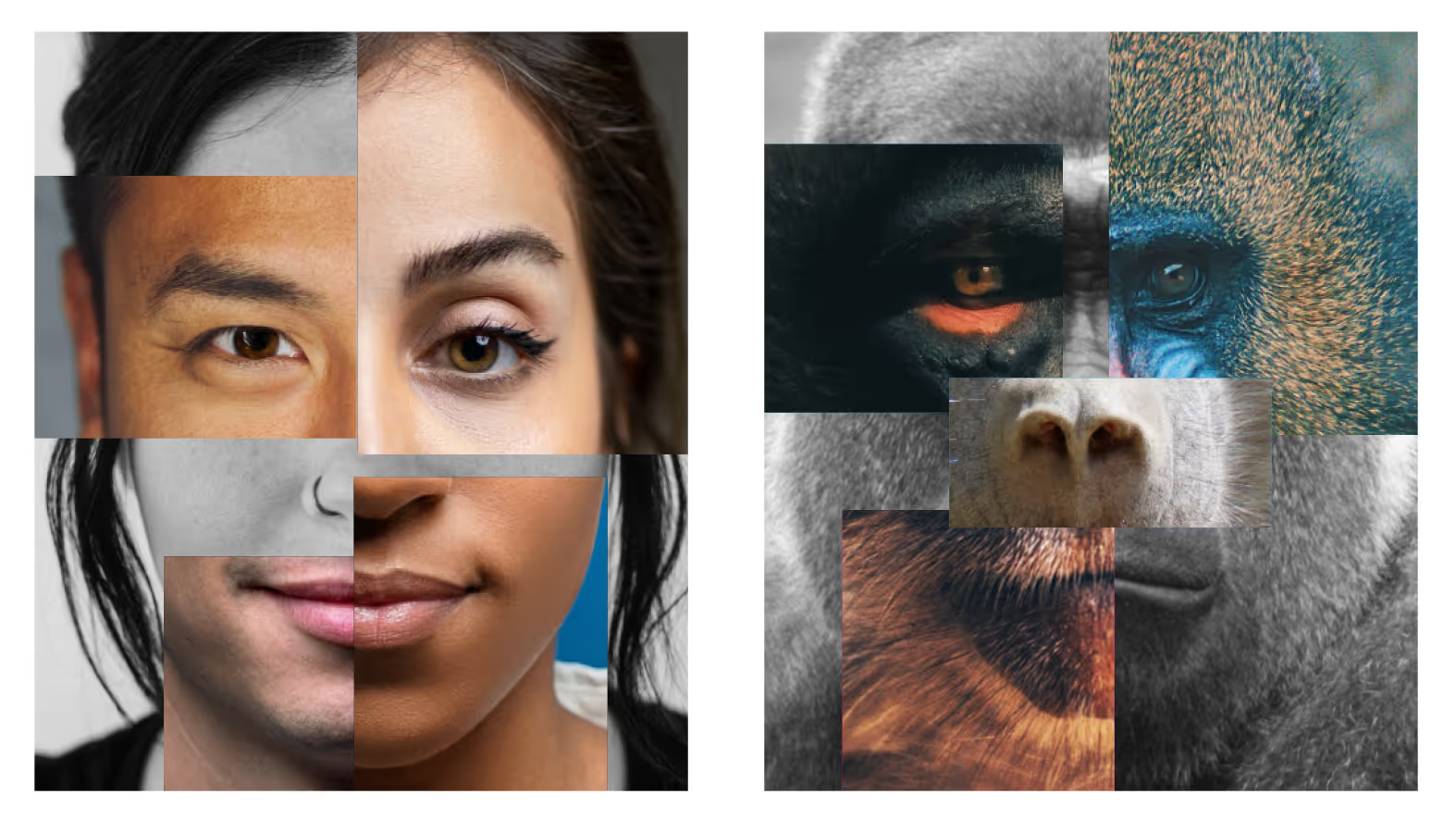
CodeXome began with a scientific observation: humans share approximately 20,000 protein-coding genes with their closest evolutionary relatives, and 87 million years of primate evolution contains a record of which changes nature has tolerated and which it has not.
The biological resource that makes this observation usable — one of the most comprehensive primate sample collections ever assembled by a public research institution — was preserved through the closure of its original NCI laboratory and relocated to a formal research facility under NSF Phase II funding. 55 genera, 19,244 genes. Assembled, curated, and released for researchers to use today.

.jpg)
We're partnering with research groups working on rare disease, hereditary cancer, and gene-targeted therapeutics.