
Evolutionary conservation measures how similar a DNA or protein sequence remains across species. A position is considered highly conserved when the same nucleotide or amino acid appears repeatedly across the organisms included in an alignment.
Conservation is one of the most widely used signals in comparative genomics.
When a residue remains unchanged across long periods of evolution, researchers often infer that it contributes to an important biological function. A damaging substitution at that position may have been removed by natural selection before it could persist in a population.
Conservation scores summarize this pattern. They help researchers identify positions that changed less often than expected.
That is valuable information, but it does not capture the full evolutionary history of a residue.
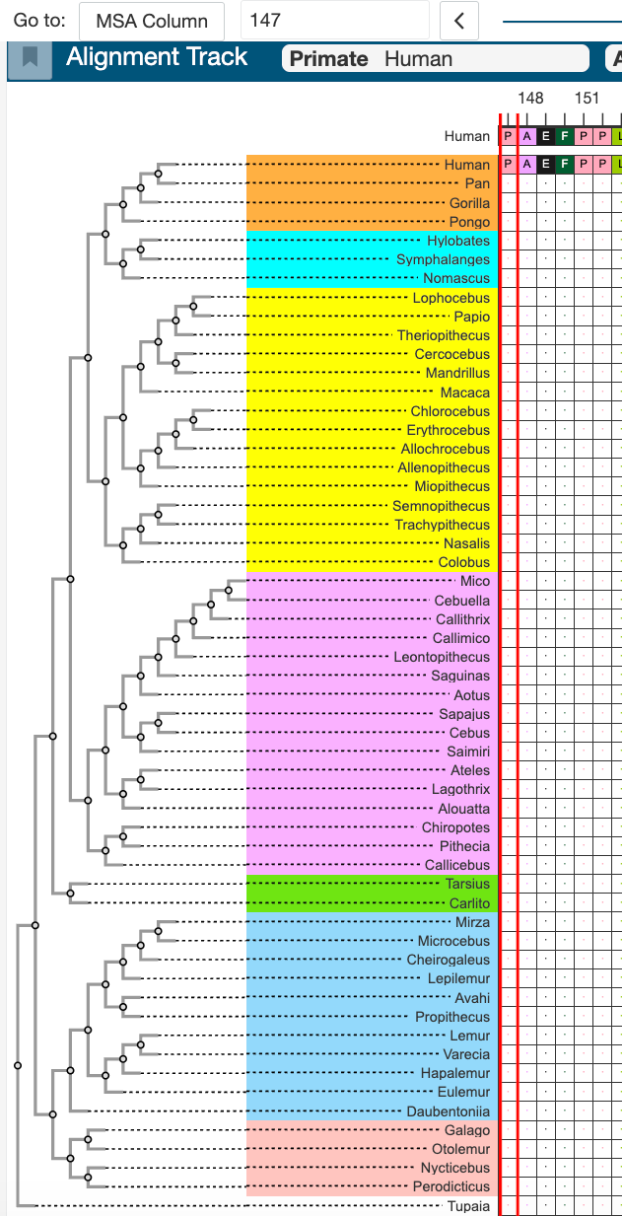
Figure 1. A residue that remains unchanged across primate lineages provides evidence of strong evolutionary conservation.
What is evolutionary constraint?
Evolutionary constraint describes the boundaries natural selection places on genetic variation. It asks not only whether a position changed, but which substitutions occurred, which substitutions persisted, and which classes of change appear to have been rejected.
A residue does not need to remain perfectly identical to be constrained.
Some positions tolerate only chemically similar amino acids. Others permit substitutions in a small number of lineages but remain unchanged everywhere else. A more flexible position may accept several amino acids without an apparent loss of biological function.
These patterns reflect different levels and forms of constraint.
Constraint therefore provides more detail than a single measure of similarity. It describes the limits of variation observed across evolutionary time.
CodeXome was built to make these patterns visible using a proprietary primate exome dataset spanning 55 nonhuman primate genera, with data mapped to the human GRCh38 reference across 19,244 genes.
What is the difference between conservation and constraint?
Conservation asks whether a position stayed the same. Constraint asks what kinds of change biology allowed at that position. A conserved position may show no observed substitutions, while a constrained position may permit a narrow and biologically meaningful set of substitutions.
Consider two amino acid positions.
In Figure 1, MSA 147, every observed primate lineage carries proline. No other amino acid appears. This position is highly conserved and appears strongly constrained.
In Figure 2, MSA 124, most primates carry isoleucine, but several lineages carry leucine or valine. The position is less strictly conserved, but it is not biologically unrestricted. Every observed amino acid maintains a similar hydrophobic property.
Natural selection appears to permit a narrow class of substitutions while rejecting others.
A conservation score can summarize the amount of sequence similarity at each position. It may not show the exact substitutions that occurred, their phylogenetic distribution, or the biochemical boundaries suggested by those substitutions.
Constraint preserves that context.
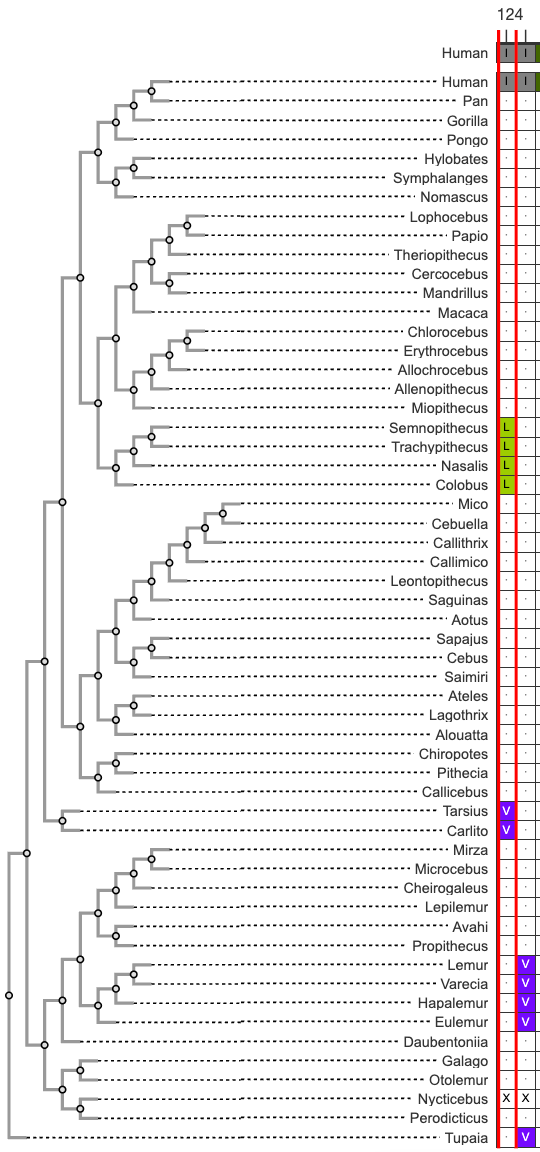
Figure 2. This amino acid 124 is not perfectly conserved, but its variation is constrained to a limited set of chemically similar amino acids.
Can a residue change and still be constrained?
Yes. A residue can vary across species while remaining under strong evolutionary constraint. The key question is whether substitutions occur freely or remain limited to specific amino acids, biochemical properties, lineages, or evolutionary transitions.
A variable position is not automatically unimportant.
Imagine that one residue alternates only between glutamate and glutamine across primate evolution. Those amino acids have related structures, although they differ in charge. The pattern provides evidence that the position can tolerate a specific chemical shift while remaining incompatible with more disruptive substitutions.
Another residue may change repeatedly among many unrelated amino acids. That broader range suggests greater tolerance.
Both positions changed. Their biological histories are not equivalent.
This is why residue-level evolutionary evidence matters. The identity, timing, and phylogenetic pattern of each substitution can reveal more than the simple fact that a change occurred.
Why does evolutionary recurrence matter?
Evolutionary recurrence occurs when the same amino acid state appears in more than one lineage or persists across related lineages. Recurrent substitutions can provide empirical evidence that a particular state has been compatible with survival and reproduction in a primate biological context.
A computational predictor estimates what a variant might do.
Evolutionary recurrence records what happened.
When a substitution persisted through natural selection, it became part of the evolutionary record. Unlike a computational prediction, this is an observed biological outcome: the amino-acid state existed and persisted within a functioning primate lineage.
Recurrence across lineages adds another dimension. It allows researchers to distinguish isolated evolutionary events from substitutions that have repeatedly proven compatible with primate biology.
CodeXome preserves that evidence at the residue level—the substitution itself, where it occurred, whether it recurred, and its phylogenetic context—so researchers can examine functional tolerance directly rather than infer it solely from a summarized conservation score or predictive model.
Genetic background and lineage-specific biology remain part of that evolutionary context, which is precisely why preserving the underlying phylogenetic pattern matters.
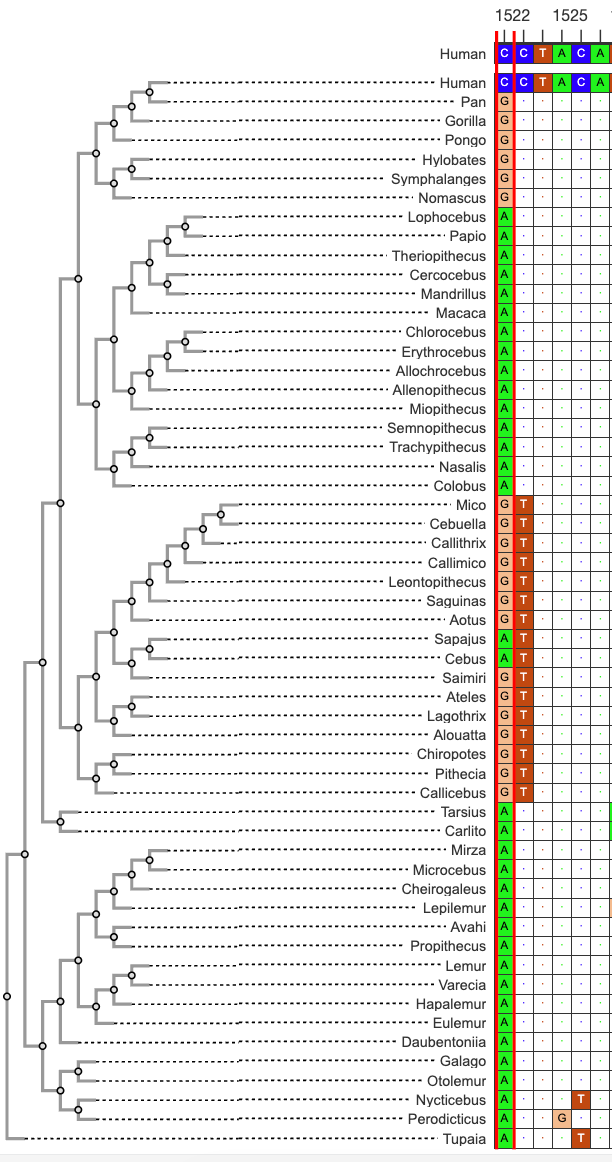
Figure 3. Position 1522 provides empirical evidence of biological tolerance across primate lineages.
Why is constraint useful for variant interpretation?
Constraint distinguishes positions that accept broad variation from positions where natural selection has permitted little or no change, providing a direct biological basis for prioritizing variants for deeper review, functional testing, or investigation.
A human missense variant at a residue that has remained invariant across primate evolution occurs at a position where natural selection has strongly restricted change. That history is itself evidence of functional constraint and makes the variant biologically important to investigate.
A variant that matches an amino acid observed naturally across several primate lineages presents a fundamentally different biological pattern. The substitution has already occurred and persisted through natural selection, providing empirical evidence that the amino-acid state has been tolerated in primate biology. That evidence can materially change the priority assigned to the variant.
Evolution changes the question.
Instead of asking only whether a computer predicts damage, a researcher can ask:
- Has this exact substitution appeared in primate evolution?
- Has this residue remained invariant?
- Do observed substitutions preserve the same biochemical property?
- Did the change arise once or recur across lineages?
- Is the human variant introducing a state not observed anywhere else in the dataset?
- Does the surrounding region show broad tolerance or deep constraint?
These questions provide interpretable biological context before expensive experiments or intensive manual review.
How is constraint different from a conservation score?
A conservation score compresses evolutionary similarity into a numerical value. A constraint analysis can retain the underlying residue states, lineage patterns, recurrence, and tolerated substitutions that produced that signal.
Tools such as phyloP, phastCons, and GERP are valuable components of genomic analysis. They summarize patterns across multispecies alignments and help identify conserved or evolutionarily unusual regions.
CodeXome addresses a related but distinct question.
Its primate-focused approach allows researchers to inspect residue-level amino acid observations across a near-human evolutionary window. The platform presents the substitutions themselves rather than asking users to rely only on a summarized score.
This distinction is especially important when a researcher wants to understand why a position appears tolerant or constrained.
A score can indicate that a position matters.
The underlying evolutionary record can show how biology behaved at that position.
Why focus on primate evolution?
Primate evolution offers a useful middle distance between recent human variation and deep vertebrate conservation. Primates are closely related enough to retain strong biochemical relevance to human proteins, while their divergence provides millions of years of natural variation and selection.
Human population databases sample variation that exists among people living today or in the recent past. These resources are indispensable, but rare variants and underrepresented populations remain difficult to interpret using frequency alone.
Deep vertebrate comparisons provide a much longer evolutionary view. That depth is valuable, but distant species can differ substantially in protein context, physiology, and selective pressures.
Primate data occupies the space between those extremes.
CodeXome draws on exome data from 55 primate genera and maps those observations to human coordinates. This makes it possible to examine which amino acids persisted in organisms that are evolutionarily close to humans while still representing approximately 80 million years of natural selection.
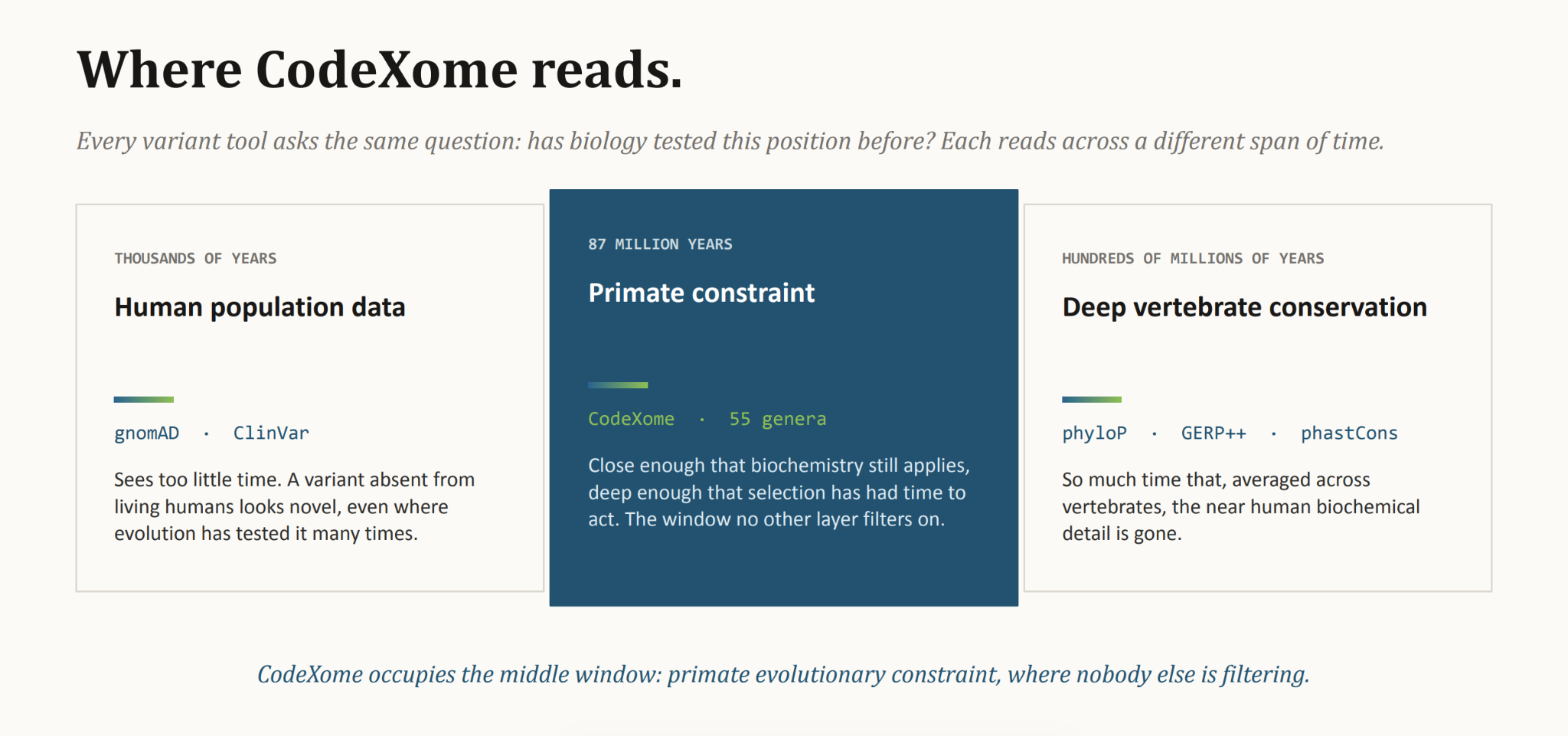
Figure 5. Primate evolutionary evidence occupies a biologically informative interval between recent human population variation and deep vertebrate conservation.
What can evolutionary constraint reveal about functional effect?
Evolutionary constraint reveals the functional boundaries within which a residue has evolved.
When a position remains invariant across broad primate diversity, natural selection has repeatedly preserved that amino acid despite millions of years of opportunity for variation. That pattern provides evidence that change at the position has been strongly restricted.
When a particular substitution occurs and persists across primate lineages, the evolutionary record provides empirical evidence that the resulting amino-acid state has been biologically tolerated.
These observations do not come from a prediction of what a sequence change might do. They come from biological outcomes that have already occurred under natural selection.
That distinction is central to CodeXome. Researchers can examine not simply whether a residue is “conserved,” but the actual history of variation at that position: what changed, what persisted, what recurred, and what remained invariant.
Genetic background, compensatory changes, and lineage-specific adaptations can sometimes influence the effect of individual substitutions. Preserving phylogenetic context therefore strengthens the interpretation rather than reducing evolutionary evidence to a universal yes-or-no rule.
How does CodeXome show evolutionary constraint?
CodeXome presents primate recurrence, residue-level variation, invariant positions, codon changes, and phylogenetic patterns in an interactive research environment. Researchers can inspect the evidence underlying a signal instead of relying solely on a black-box prediction.
The platform combines the proprietary primate dataset with resources such as ClinVar, gnomAD, UniProt, and NCBI gene information. Researchers can move from a human gene or variant to its broader evolutionary context within the same workflow.
Useful views may include:
- Gene Profile
- protein or amino acid alignment
- Codon View
- variant-level recurrence
- lineage-specific substitutions
- constrained and variable regions
- integrated clinical and population annotations
These views allow a researcher to see not only that a position is unusual, but why.
What should researchers take away from the distinction?
Conservation identifies similarity. Constraint describes biological limits. Both are useful, but they should not be treated as interchangeable measures of the same thing.
A residue that never changes tells one story.
A residue that changes only among chemically similar amino acids tells another.
A residue that repeatedly accepts many different substitutions tells a third.
Each pattern provides information about what natural selection preserved, permitted, or removed.
For variant interpretation, that difference matters. Researchers need more than a statement that a position is conserved. They need to understand the evolutionary behavior of the residue itself.
That is where conservation ends and constraint begins.
Frequently asked questions
Is conservation the same as evolutionary constraint?
No. Conservation measures sequence similarity across species. Evolutionary constraint examines the range and pattern of substitutions that natural selection has permitted.
Can a variable residue still be constrained?
Yes. A position can accept a limited set of substitutions while rejecting others. The position is variable, but the variation remains biologically constrained.
What does it mean when a human variant appears in another primate?
Its occurrence provides empirical evidence that the same amino-acid state has been tolerated in a primate biological context. Recurrence across multiple lineages can strengthen that evidence by showing that the state is not limited to a single evolutionary event. CodeXome preserves the phylogenetic context needed to distinguish broad evolutionary tolerance from lineage-specific or potentially compensatory patterns.
Does CodeXome replace phyloP or phastCons?
No. phyloP and phastCons are valuable tools for measuring broad conservation across multispecies alignments, but they answer a different question. Their strength is evolutionary breadth; they are not designed to provide a phylogenetically focused, residue-level record of what variation has actually been tolerated within primates.
CodeXome was built specifically around that gap. Rather than collapsing highly divergent species into a single conservation signal, CodeXome uses broad representation across the primate order to examine recurrence, tolerated substitutions, constraint, and lineage context at individual residues. This preserves near-human biological relevance while capturing millions of years of natural selection.
Why are exact amino acid substitutions important?
Two substitutions at the same residue can have very different biochemical effects. Examining the exact states observed across evolution provides more detail than knowing only whether the residue changed.