
Thousands of inherited conditions are linked to changes in DNA that alter how proteins function, yet researchers are often left with long lists of candidate variants and limited evidence for deciding which ones deserve deeper investigation. Many available tools address this problem through population frequency, computational prediction, or composite pathogenicity scores.
CodeXome adds a different kind of evidence: a direct record of what evolution has already tested across primate lineages. Rather than asking only what a model predicts a variant might do, CodeXome shows how the same residue has behaved over tens of millions of years of natural selection.
Let’s Explore BRCA1 Together
Cornerstone Genomics first tested the biological premise underlying CodeXome against expert-curated clinical variant datasets.
In the ClinGen analysis, variants from reviewed genes were cross-referenced against the CodeXome primate database. The pattern was striking: variants classified as benign or likely benign frequently recurred across primate lineages, while pathogenic and likely pathogenic variants were almost entirely absent from the primate record.
The same pattern appeared when the analysis was applied specifically to BRCA1 and BRCA2 variants curated through the ENIGMA consortium and BRCA Exchange.
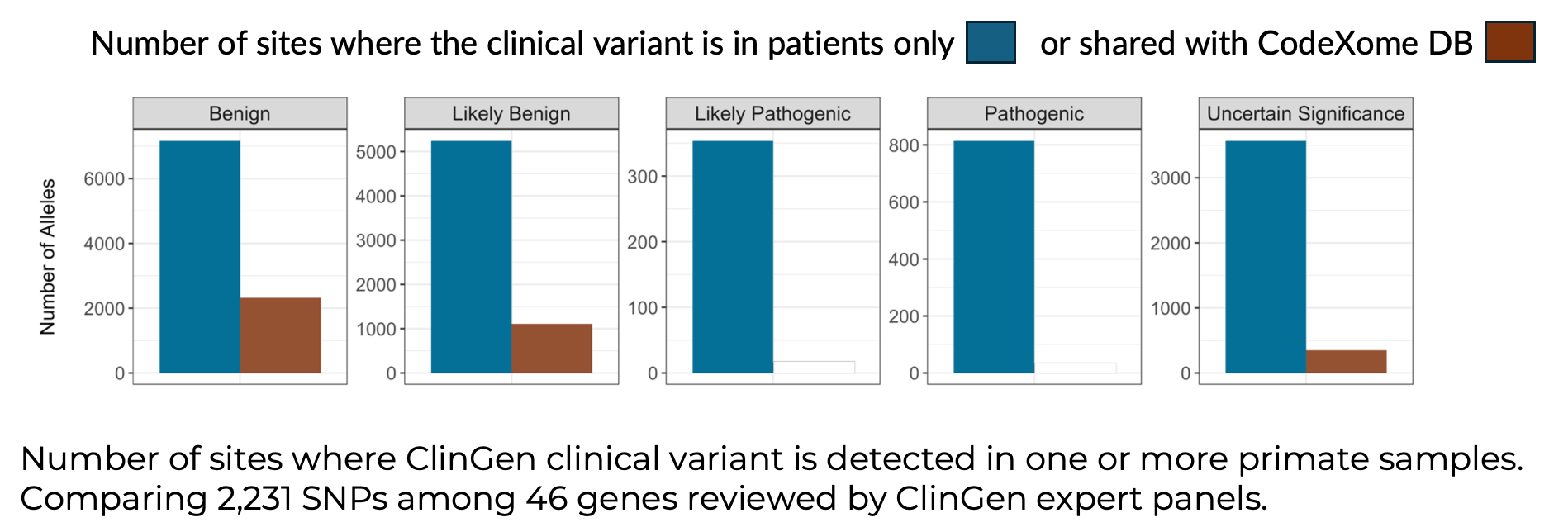
For researchers, this provides a useful first-pass filter. Variants that recur naturally across primates can be deprioritized as evolutionarily tolerated, allowing attention to shift toward variants that are human-unique, occur at constrained positions, or otherwise warrant closer functional investigation.
Why the Full Primate Order Matters
Line up BRCA1 across humans, chimpanzees, and the other great apes, and much of the sequence appears nearly featureless. Most residues match the human reference, producing long stretches of identical sequence.
That similarity is expected for an essential protein such as BRCA1. But it also limits what the comparison can reveal. If every species in the alignment carries the same amino acid, researchers learn that the position is conserved among those species—but little about the broader range of change the protein may have tolerated throughout primate evolution.
The biological history becomes more informative when the comparison expands beyond our nearest relatives to include the full primate order.
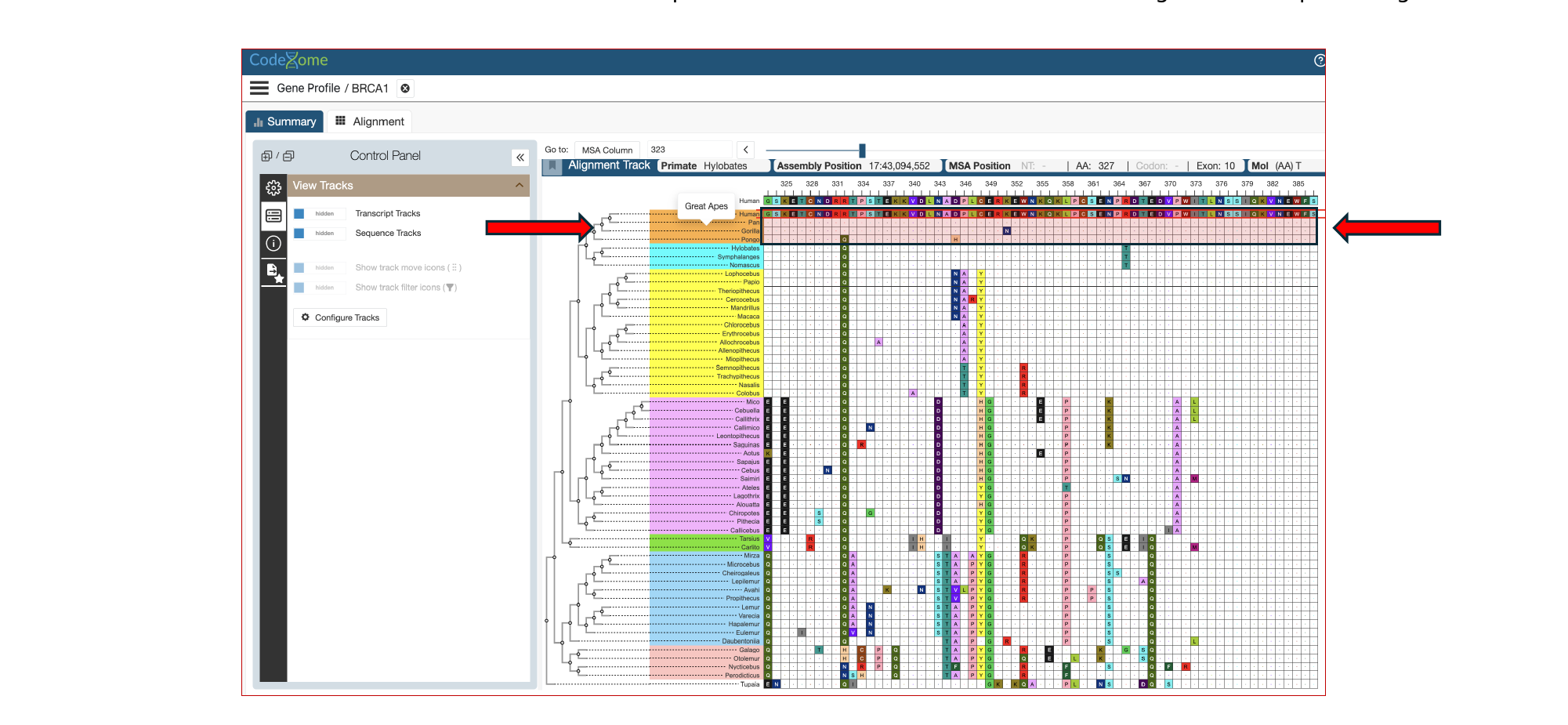
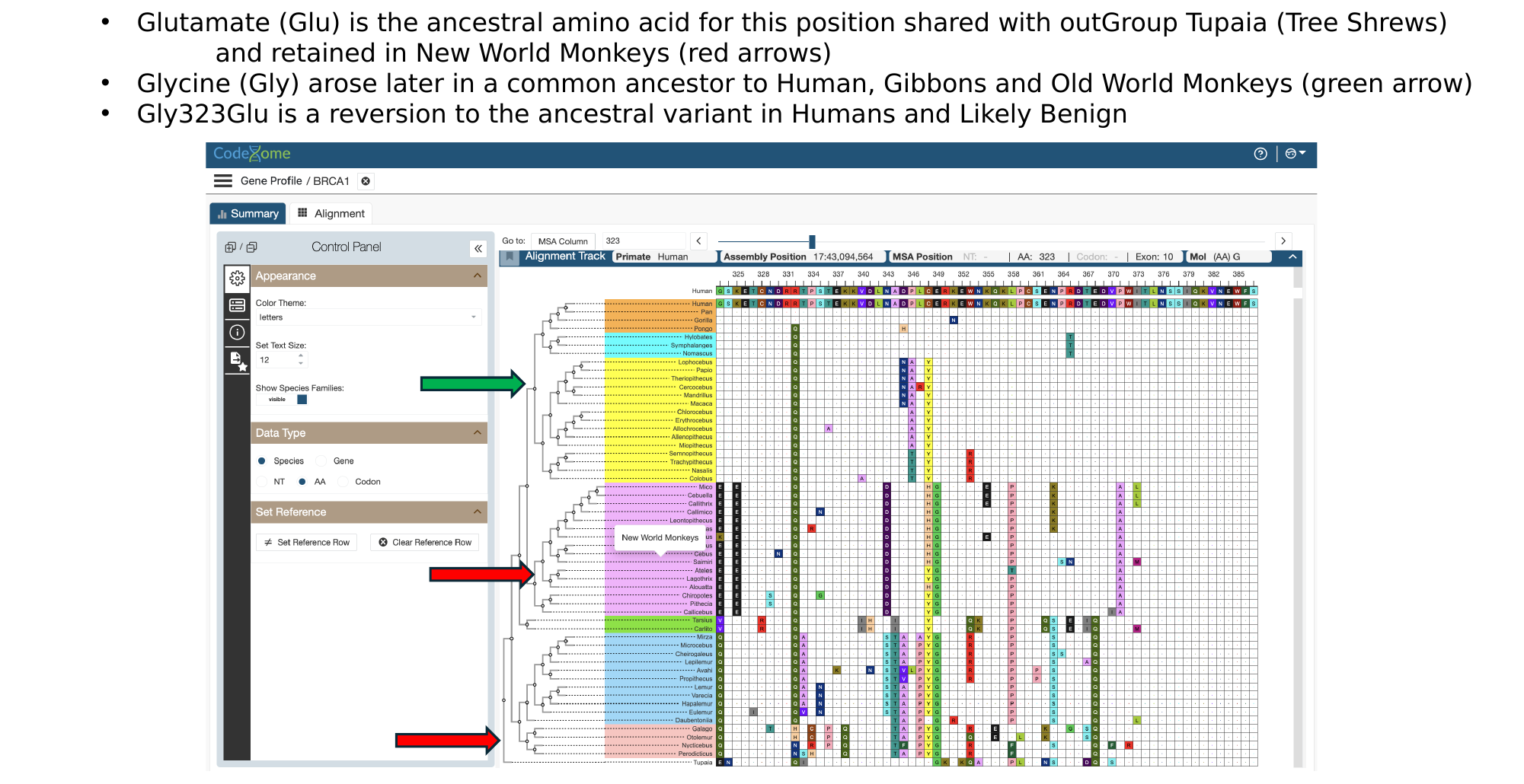
When the alignment is widened, position 323 becomes visible as a genuinely informative site. Rather than remaining fixed throughout primate evolution, the residue preserves a branching history of multiple tolerated amino-acid states, including glutamate, the amino acid introduced by the human Gly323Glu variant.
Here’s What Evolution Actually Shows
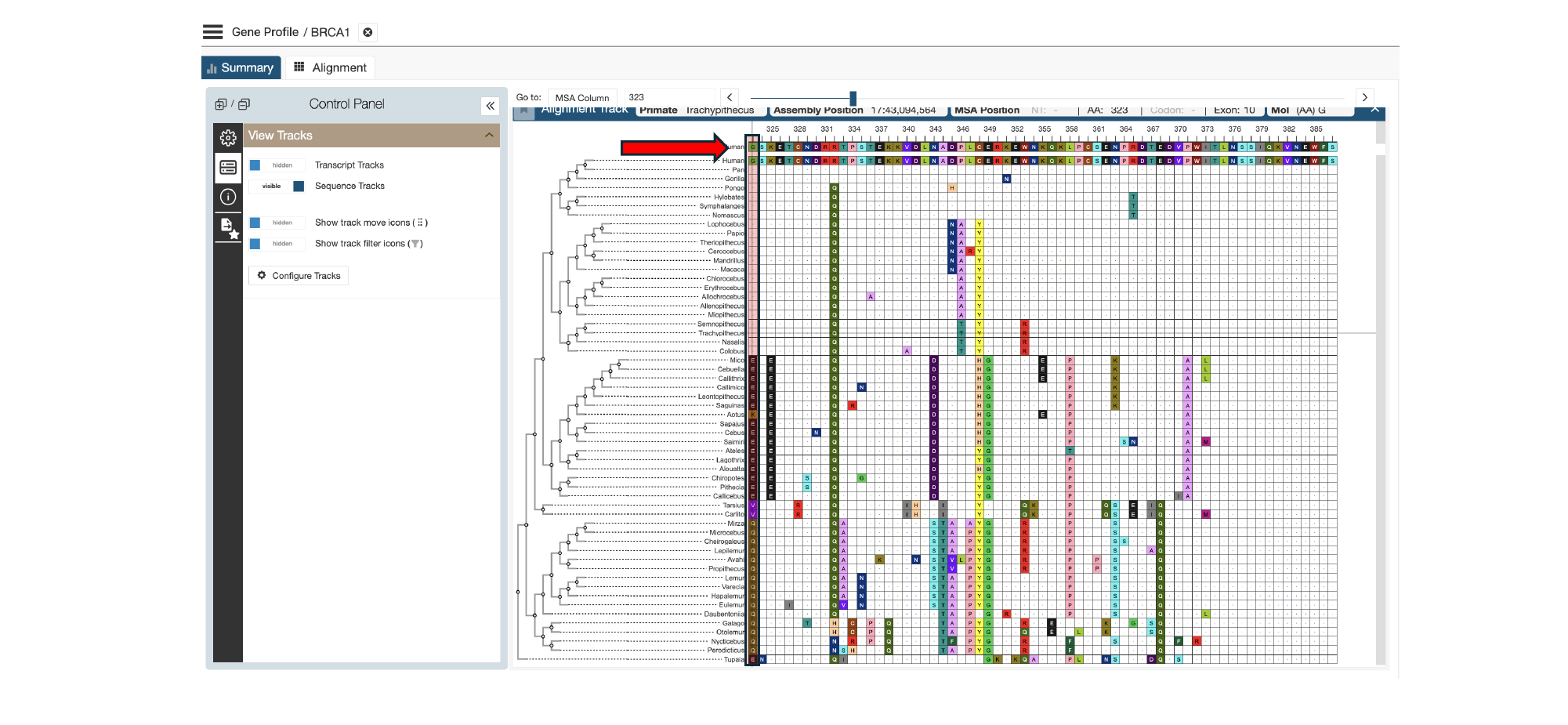
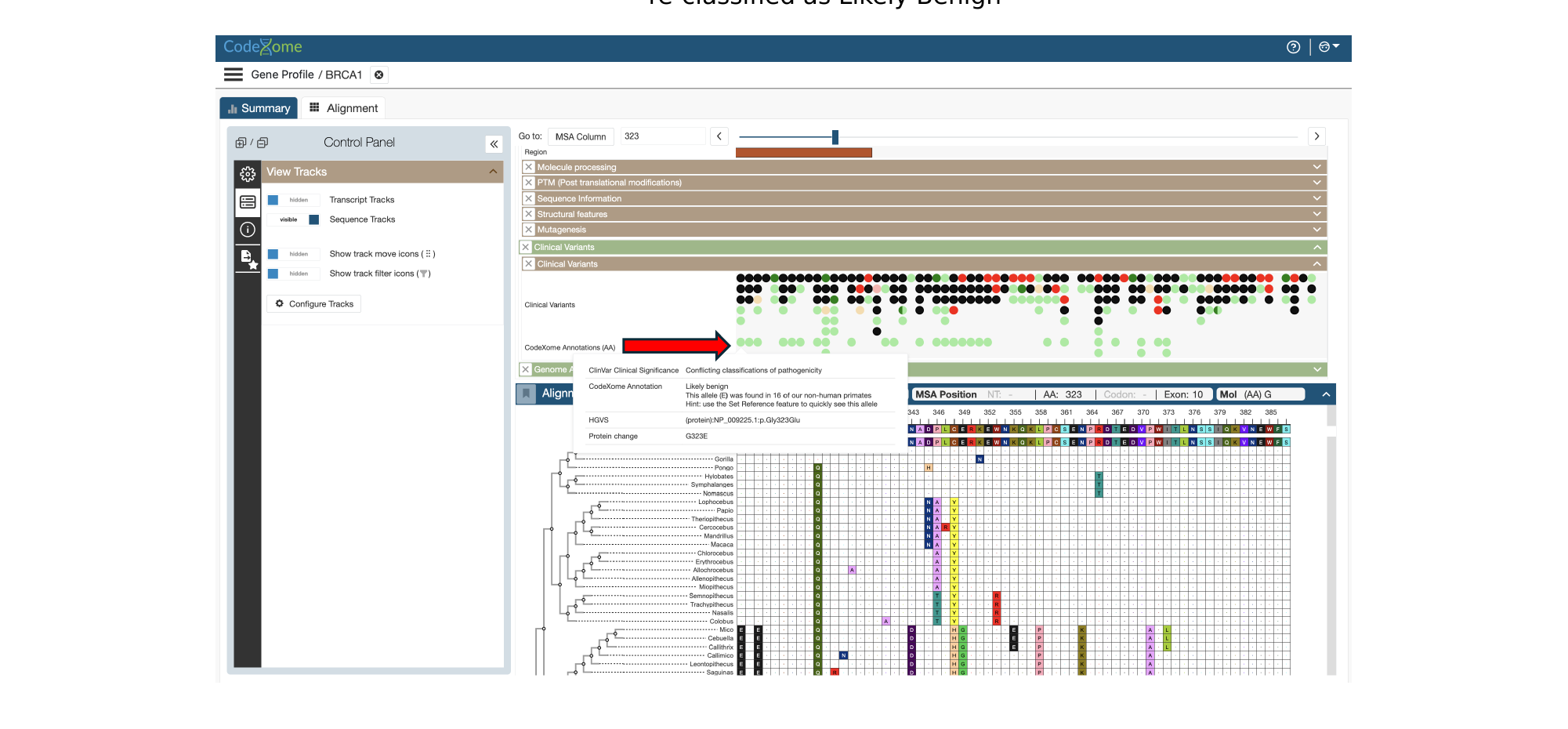
Gly323Glu appears in ClinVar among BRCA1 variants with uncertain or conflicting interpretations. CodeXome adds another layer of evidence to that record: the observed evolutionary history of the residue itself. At position 323, the amino-acid pattern did not move directly from one ancestral state to the modern human state. It changed at multiple points across the primate tree.
The position first arose as glutamate, or E, the ancestral amino-acid state. It later evolved to glutamine, or Q, in a common ancestor of more distantly related primate lineages. Glutamate remained unchanged in New World monkeys. Glycine, or G, then evolved in the common ancestor of Old World monkeys, gibbons, great apes, and humans.
In simplified form, the history is:
- E → Q in an ancestral primate lineage
- E retained in New World monkeys
- G arising in the common ancestor of Old World monkeys and apes
These transitions occurred over tens of millions of years, showing that position 323 has supported several amino-acid states across different primate lineages. That pattern changes how the human Gly323Glu variant should be understood.
The variant does not introduce a completely new amino acid at a previously invariant position. It changes the modern human glycine back to glutamate, the ancestral state that persisted naturally in New World monkeys. Gly323Glu is therefore a reversal to a previously tolerated ancestral condition.
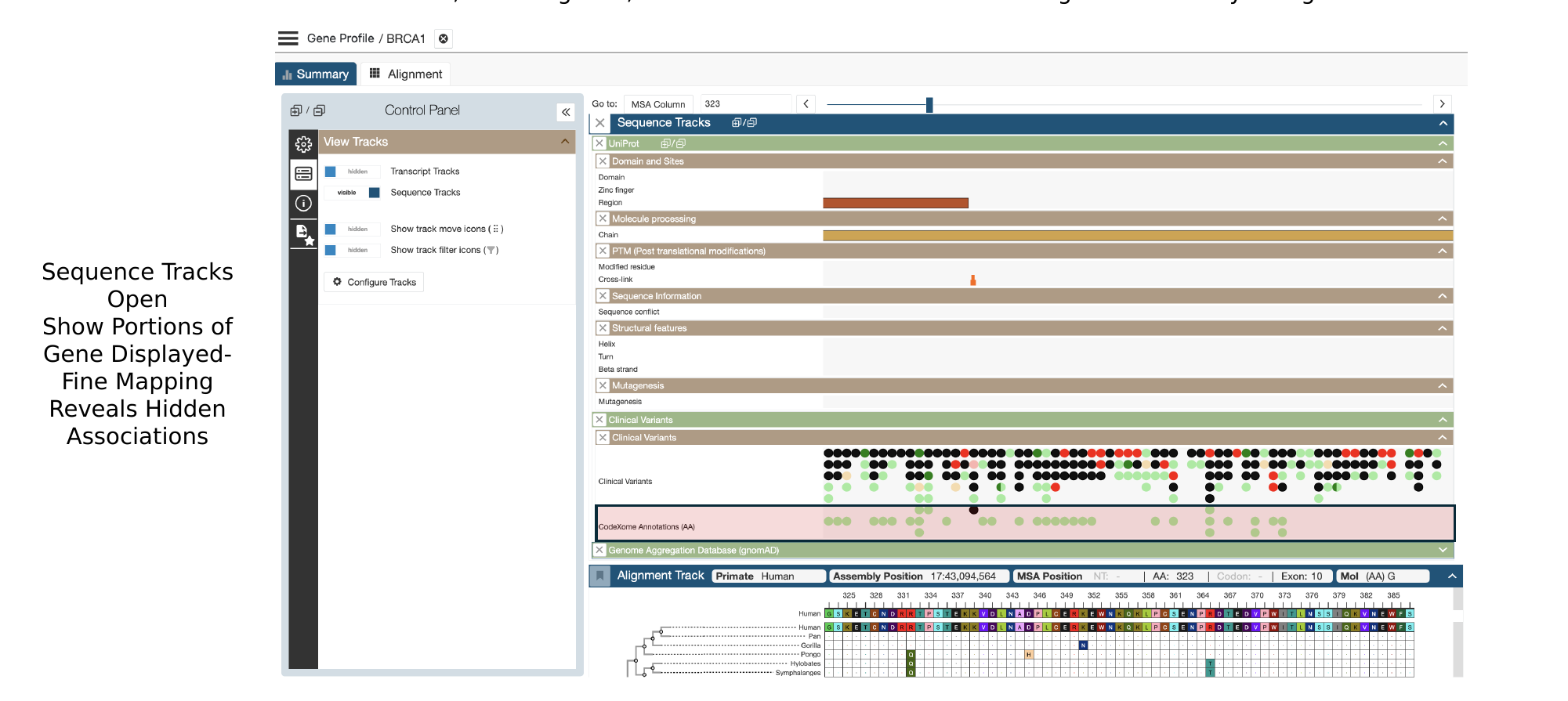
Across BRCA1, nearly 30% of the VUS and conflicting records examined in this analysis carry primate recurrence evidence consistent with evolutionary tolerance. This does not independently establish a clinical classification. It gives researchers a biological reason to deprioritize those variants relative to variants that are absent from primates or occur at deeply constrained residues.
A Reversal, Not a Novel Disruption
Viewed without evolutionary context, Gly323Glu is simply a substitution from glycine to glutamate. Viewed across the primate tree, it tells a more complete story.
Glutamate was present first. Other amino-acid states emerged later in separate lineages. Glycine eventually became established in the lineage leading to Old World monkeys, apes, and humans. The human variant reverses that more recent glycine state back to the older glutamate state.
This is the kind of distinction a conventional pathogenicity score may not make visible. A score can estimate whether a substitution is likely to affect protein function. The phylogenetic record can show whether the exact amino-acid state has already existed and persisted through natural selection.
CodeXome therefore identifies Gly323Glu as evolutionarily consistent with a likely-benign interpretation. The platform places that evolutionary evidence directly beneath ClinVar’s existing record, allowing researchers to compare the clinical annotation with the residue’s primate history in the same view.
From One Residue to a Research Workflow
The BRCA1 example demonstrates a broader workflow. A researcher uploads variant data to the CodeXome cloud platform, where the variants are cross-referenced against a proprietary comparative dataset spanning 55 non-human primate genera and 19,244 human genes mapped to GRCh38 coordinates.
Variants that recur naturally across primate lineages can be identified as evolutionarily tolerated and deprioritized before expensive downstream review or functional validation.
The remaining variants can then be evaluated according to:
- whether the residue is constrained across primates;
- whether the substitution is absent from the evolutionary record;
- where the residue occurs within the gene and protein;
- how the variant compares with ClinVar and gnomAD evidence; and
- whether it overlaps a known UniProt domain, motif, or functional region.
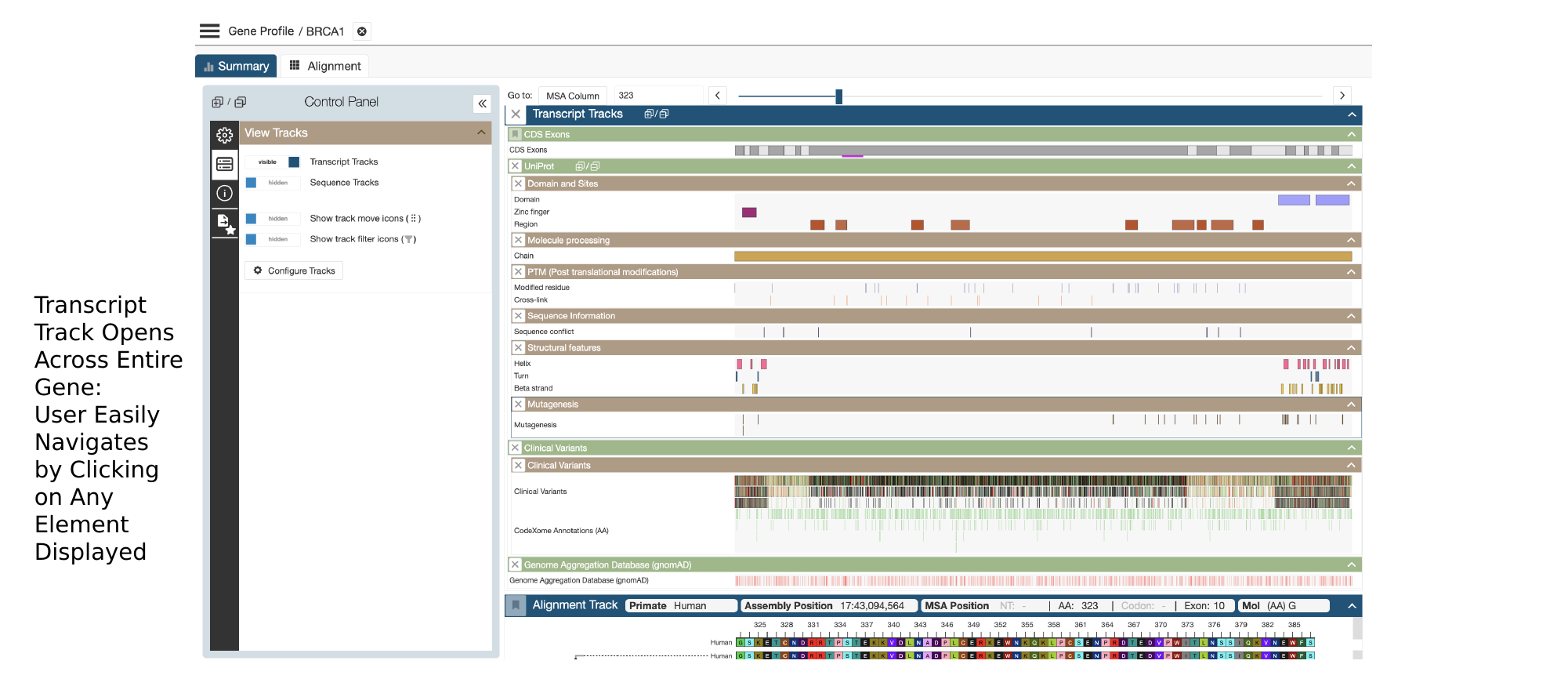
CodeXome brings these evidence sources together in a single environment, allowing researchers to move from a variant list to a biologically informed shortlist without treating any one prediction score as the final answer.
See Where Biology Tolerates Change
Evolutionary recurrence is useful because it reveals more than whether a position is simply conserved. It shows where a gene has tolerated change, which amino-acid substitutions have persisted, and how those states are distributed across the primate tree.
A residue that is identical in humans and chimpanzees may still vary across more distant primates. A substitution that appears novel in a human-only dataset may actually represent an ancestral state. A region that looks broadly conserved may contain individual positions with distinct histories of tolerance and constraint. CodeXome makes those histories visible at residue-level resolution.
The platform is not intended to replace ACMG frameworks, functional studies, clinical evidence, or researcher judgment. It functions upstream of those decisions as an evolutionary constraint and biological plausibility layer, helping researchers determine which variants deserve the most attention and which may represent natural background variation.
An Evidence Source Independent of Human Population Structure
The underlying evidence also differs from human population frequency data.
Population databases are essential, but their ability to inform variant interpretation depends partly on which populations have been sampled and how well they are represented. A variant may appear rare because it is truly unusual, or because the relevant population has limited representation in available datasets.
Primate evolutionary evidence is derived from a different source. It asks whether the amino-acid state has persisted through natural selection across related species.
Because that evidence does not depend on the ancestry of the human patient or research cohort, it can provide an additional biological signal when human population data are sparse or uneven.
From Predicted Effect to Observed History
Most genomic workflows already include multiple prediction tools. The challenge is not necessarily adding another score. It is adding evidence that answers a different question.
A predictor asks: What effect is this variant likely to have?
CodeXome also asks: Has evolution already tested this amino-acid state?
At BRCA1 position 323, the answer is yes.
Glutamate is not an unprecedented change at this residue. It is the ancestral state, retained in New World monkeys and replaced by glycine later in the lineage leading to humans.
That does not eliminate the need for careful interpretation. It does, however, provide a biologically meaningful reason to view Gly323Glu differently from a novel substitution at an otherwise invariant residue.
This is the shift CodeXome is designed to support: from relying only on predicted effects to examining observed evolutionary history, one residue at a time.